Learn more
.jpg)
I have been making a series on Instagram about reading more Substack to replace my scrolling habit. The one I read this time deserved more than a reel. (yes, I have linked the article at the end).
One word sums up everything I want to say today.
Translation.
That word named something I had already lived through, failed at, and eventually figured out the hard way.
A few years ago I worked with a creative studio run by an artist. They were doing well. Genuinely well. They had cracked something that most studios spend years chasing: they knew exactly what their audience wanted and they delivered it consistently. They had worked with some of the biggest names on YouTube. Fast turnaround, strong results, a clearly defined value proposition to their clients. The business was working.
What they had never built was a website.
When they came to me I got excited. Good work. Real results. A defined audience. I thought I had everything I needed. What I kept getting in discovery was their story told entirely through operations. Fast delivery. Big names. View counts. How the studio ran. Every time I pushed deeper. Why does this work. Why this studio. What the real intention was behind what they had built. The conversation always bounced back to the mechanics.
I did not stop and say: what is the value here? What inspired you to build this in the first place? I told myself I understood enough. I understood the business model. I understood the audience.
So I just started designing.
And when we almost completed the project. The client hated it.
h.a.t.e.d.
Multiple revisions, back and forth, both of us increasingly confused about what the problem was. We ended the project midway. And I sat with that for longer than I would like to admit, trying to figure out exactly where it went wrong.
It took a while to pull myself out of the spiral. To land somewhere steady and say: hey. You got this. Figure out what happened and do it differently.
What had happened was this. I understood the operations. I did not understand the roots of the story. The why behind the studio had never been defined. Maybe not even to the founder himself. And I had designed a full website from assumption instead of from something real. The client kept coming back with feedback that felt vague and circular. Neither of us had language for what was missing. The problem was not the design. The problem was that there was nothing solid underneath it to translate.
A translator needs a source text.
Find The Source Text
The Metzler Lexicon Literature defines the source text as “the authentic version of a text in the source language as a template of a translation.” A source text can take any form: a letter, a dialogue, a script.
It is called “original” not because it is polished or finished, but because the word avoids positive or negative value judgments. It is simply raw. A starting point. The thing the translation reaches back to.
Brand strategy is that starting point for design. It is not the operations, the client list, the view counts, or the results deck. Brand strategy is the root of the story. Why the work exists, what the founder actually believes, what they are trying to change or offer or stand for beyond the invoice. It is the answer to “why this?” before anyone has thought to ask. Most founders have not written it down. Some have never been asked. And so when they come to work on their website, they answer every question with the thing they can see and measure. The operations. The clients. The results. That is not evasiveness. It is that no one has ever pushed them past the business model to the thing underneath it. The source text is that deeper thing. And without it, a designer is working from assumption. Even a very good designer.
Design From Assumption
When there is no brand foundation underneath, design fills the gap with what it can see. The aesthetic of the work samples. The tone of the client’s emails. A vibe. A direction that feels right without a real reason for feeling right. And it can look good. The work I produced for that studio was not embarrassing. It was technically fine.
Technically fine is not the same as true.
And the client could feel the difference even without language for it. They were not giving me bad feedback. The feedback was shaped exactly like an unanswered question. I had translated without a source text. And the result sounded like nothing in particular.
Translation > Decoration
After that project, something shifted in how I approach the work. I became more deliberate about who I take on and where we begin together. And the difference is not subtle. The founders I work with now are clear on their why before we touch a single design decision.
Not necessarily with a polished brand document or a finished deck. With real intention. They know what they are building and why they are the right person to build it. They know who they want to speak to and what they actually want those people to feel. They have done the deep work, or they are willing to do it before we start. The process feels completely different. The design choices are not arbitrary. They are answers to questions the strategy already raised. The website starts to feel like a translation of something true rather than a collection of well-made parts. They do not even need to lead with their numbers. The clarity does the work.
The founders who are stuck on their websites are almost never stuck because of bad design. I used to think the problem was the design. I kept trying to fix it at the design level. Different layout, different headline, different visual direction. The design was never the problem. The problem was that there was nothing solid underneath it to translate. Design is how your strategy shows up. Not design in the abstract sense of your visual identity. Design as the full translation of what you believe and who you are into every part of how you are experienced. The website is that translation made public. And a translation is only as clear as the source it came from.
So before the design brief. Before the discovery call. Before the moodboard or the color palette or the site map: start with your source text.
Take a piece of paper. Draw a bubble in the center and write: origin story.
Start with your once upon a time. Your beginning. Why you started. What made you the right person for this. Move to your climax: the moment the work became something more than an idea. Then your happy ending: where you are now, what you have built, what you know to be true. Keep writing. Do not let your brain interrupt the pen.
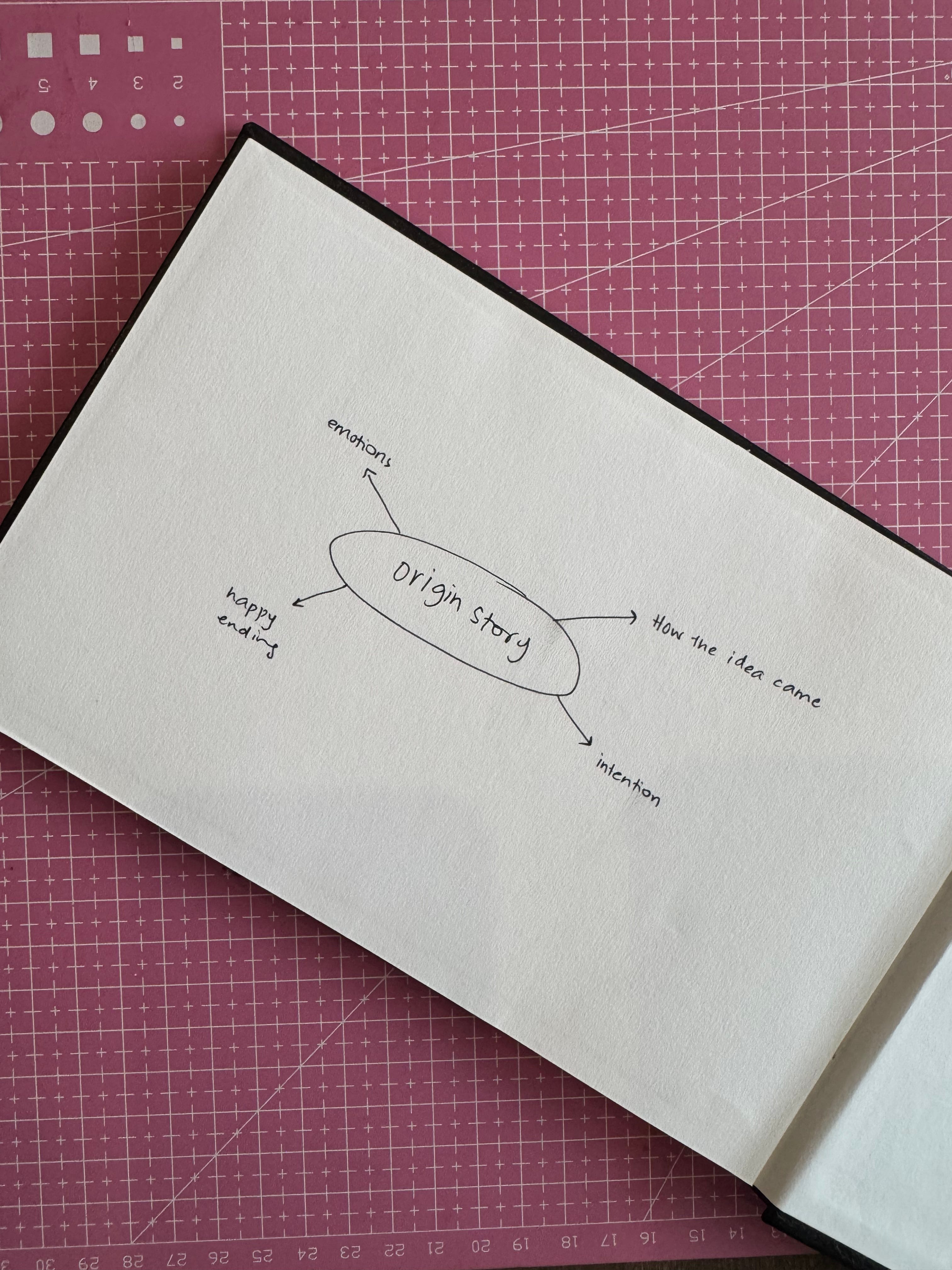
That is your source text. Whatever form it comes out in. Raw is the point.
Thanks for reading 404 Archives! If you enjoyed this issue, subscribe for free to receive future posts.
See you on Monday for the next issue.
P.S. I’m rooting for you. Always.

%20newsletterblog.png)
.png)